For landlords & property managers

Every door you own.
One place that knows it.

Haven is the software a rental business runs on — the buildings, the units, the people in them, the leases they signed, the money owed and paid, and every repair anyone has asked for. Built for the office that knows each property by name, not for a call center.

meridian.axionsoftware.dev
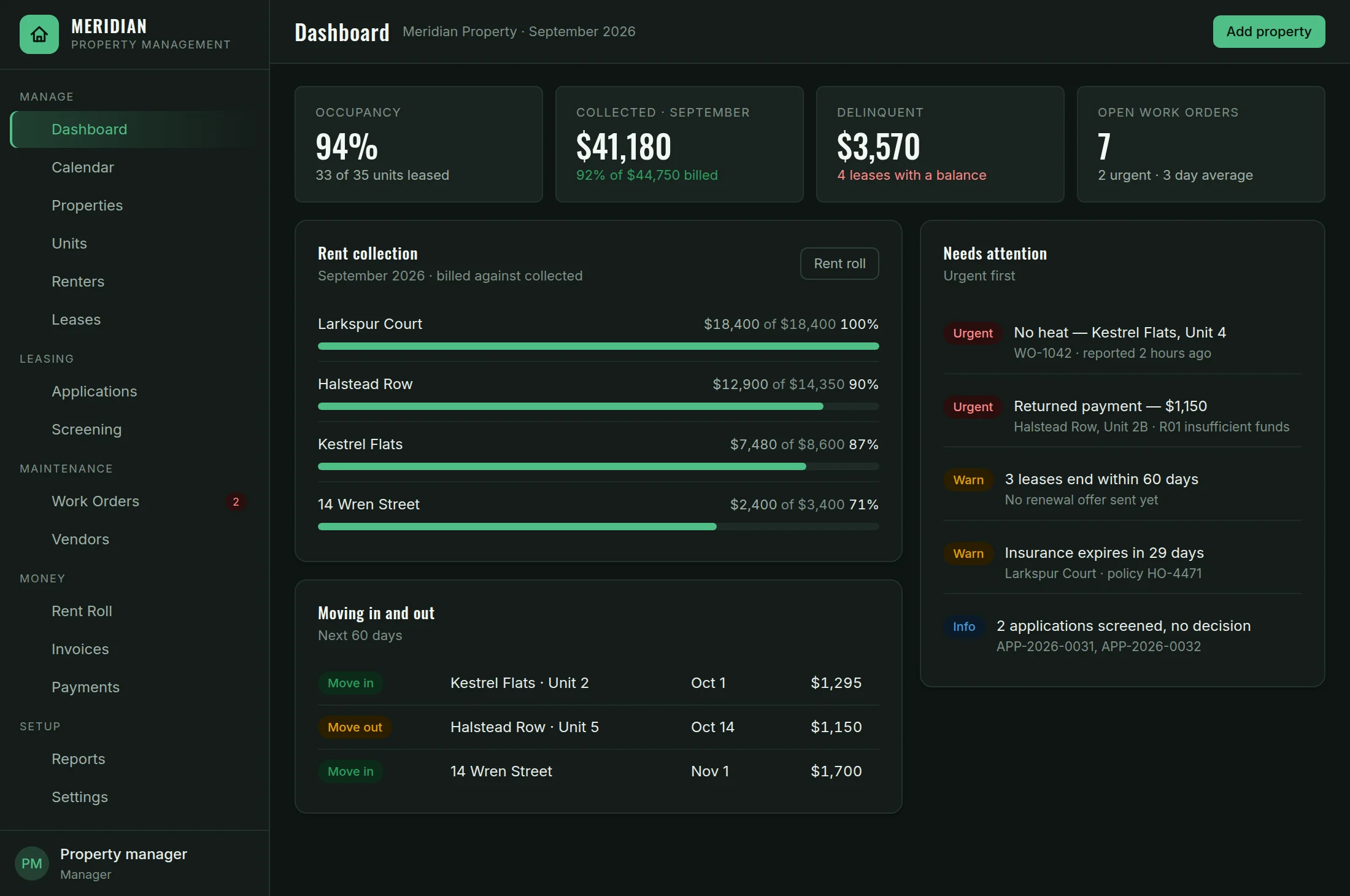
The Haven dashboard: occupancy, collected against billed for the month, delinquency, open and urgent work orders, rent collection by property, upcoming move-ins and move-outs, and a needs-attention list.
11Built-in reports, all read live from your books
$0What the property valuation costs — no data service to sign up for
5Staff roles, each with its own access
1Ledger every balance is worked out from — never a stored number
What's inside

Everything a rental office actually does

One application for the property, the people, the money and the repairs — and every figure in it traceable to the record it came from.

Properties & units

The building and the leasable thing inside it, with taxes, insurance and its expiry date, HOA dues, your management fee and the utility billback policy. Occupancy is counted from the units every time you look, never typed in, and a unit taken offline for a renovation stops counting as a vacancy you are failing to fill.

Renters & leases

A renter is a person, not a tenancy — which is what makes roommates, renewals and a returning renter work years later. The lease holds the term, the rent and its due day, recurring extras, late-fee rules, the deposit and the notice period, and a renewal writes a new lease instead of editing last year's.

Rent, charges and the ledger

Every dollar is a row on the lease's ledger. A balance is the sum of those rows, worked out when you look at it, so there is nothing to reconcile at month end. Mistakes are voided rather than deleted, and a returned payment adds rows rather than removing one — the history reads the way it happened.

Applications & screening

Applications carry their own reference, their documents and a recorded decision. Record the screening report you ran and Haven checks it against your policy, shows each test passing or failing as advice, and writes the FCRA adverse-action notice when a decline or a conditional approval owes one. An approved application converts into a renter and a lease without retyping any of it.

Maintenance & vendors

One work order per repair, against the property and the unit, with the renter's own words kept separate from your staff's interpretation. Urgent means habitability and raises a notice. Every change is appended, never edited away, and completing a renter-billable job posts that charge exactly once.

Reports an owner will read

Eleven of them: money collected, charges billed, delinquency and aging, owner statements, deposits, rent roll, occupancy and vacancy, lease expirations, maintenance, leasing, and insurance and compliance. Cash and accrual are never mixed in one figure, and every one exports to a spreadsheet.
The property page

What it looks like, and what it is worth

A page of addresses becomes a page of buildings — and answers the two questions that come up constantly, showing its workings for both.

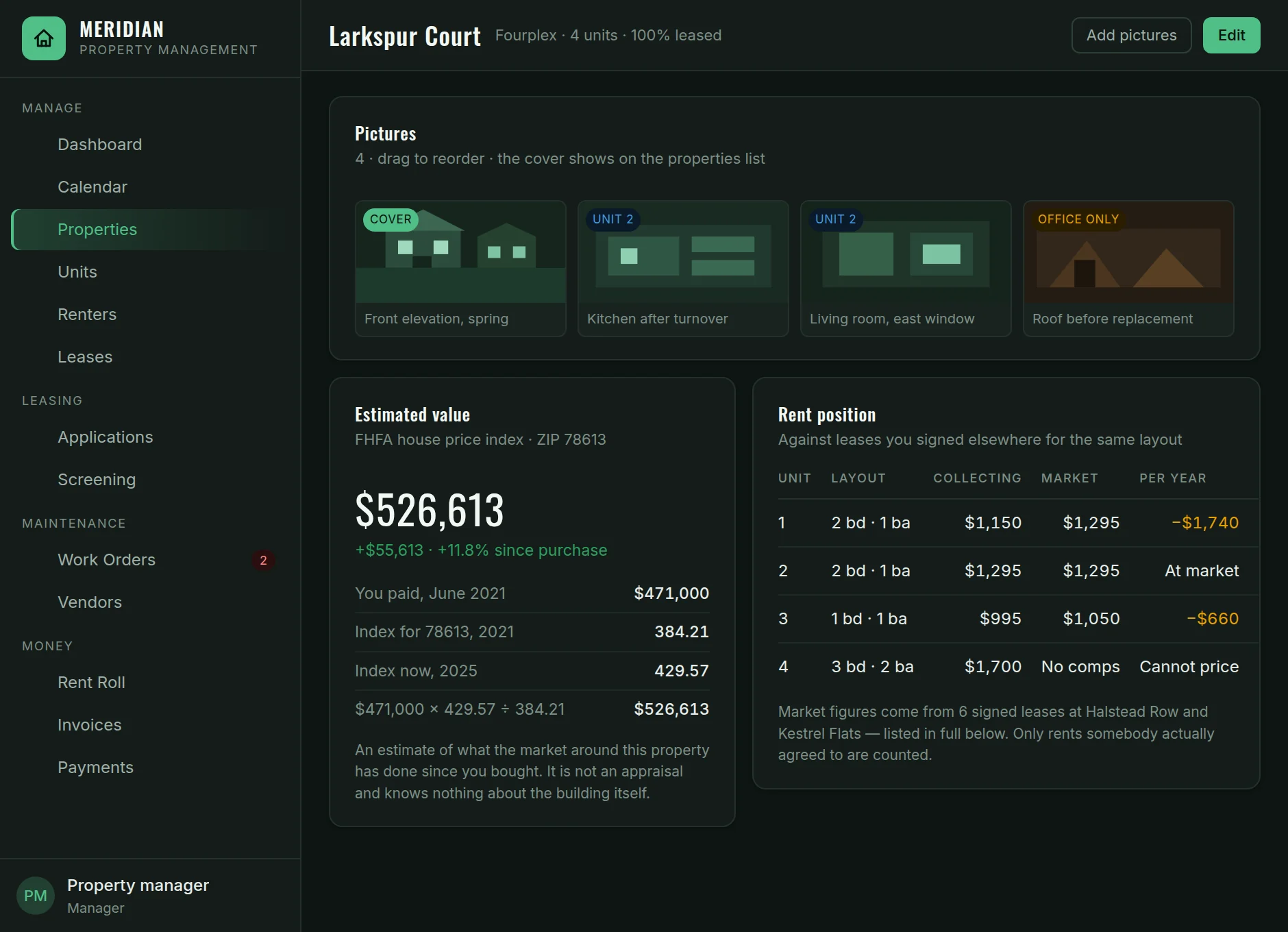
  • Twenty pictures at a time, straight off a phone, with the location stripped out before storing
  • One cover picture, shown beside the property everywhere else
  • A free valuation: what you paid, indexed forward on the federal house price index for your ZIP code — with the arithmetic on screen
  • Rent position measured against leases you signed elsewhere — only rents somebody actually agreed to

It goes down as well as up. A property bought at the top of its market shows a number below what was paid, because that is what happened.

A Haven property page: a picture gallery with a cover and an office-only tag, an estimated value showing the purchase price, both index figures and the division, and a rent position table comparing what each unit collects against market.
The month

Bill the month on purpose, not by accident

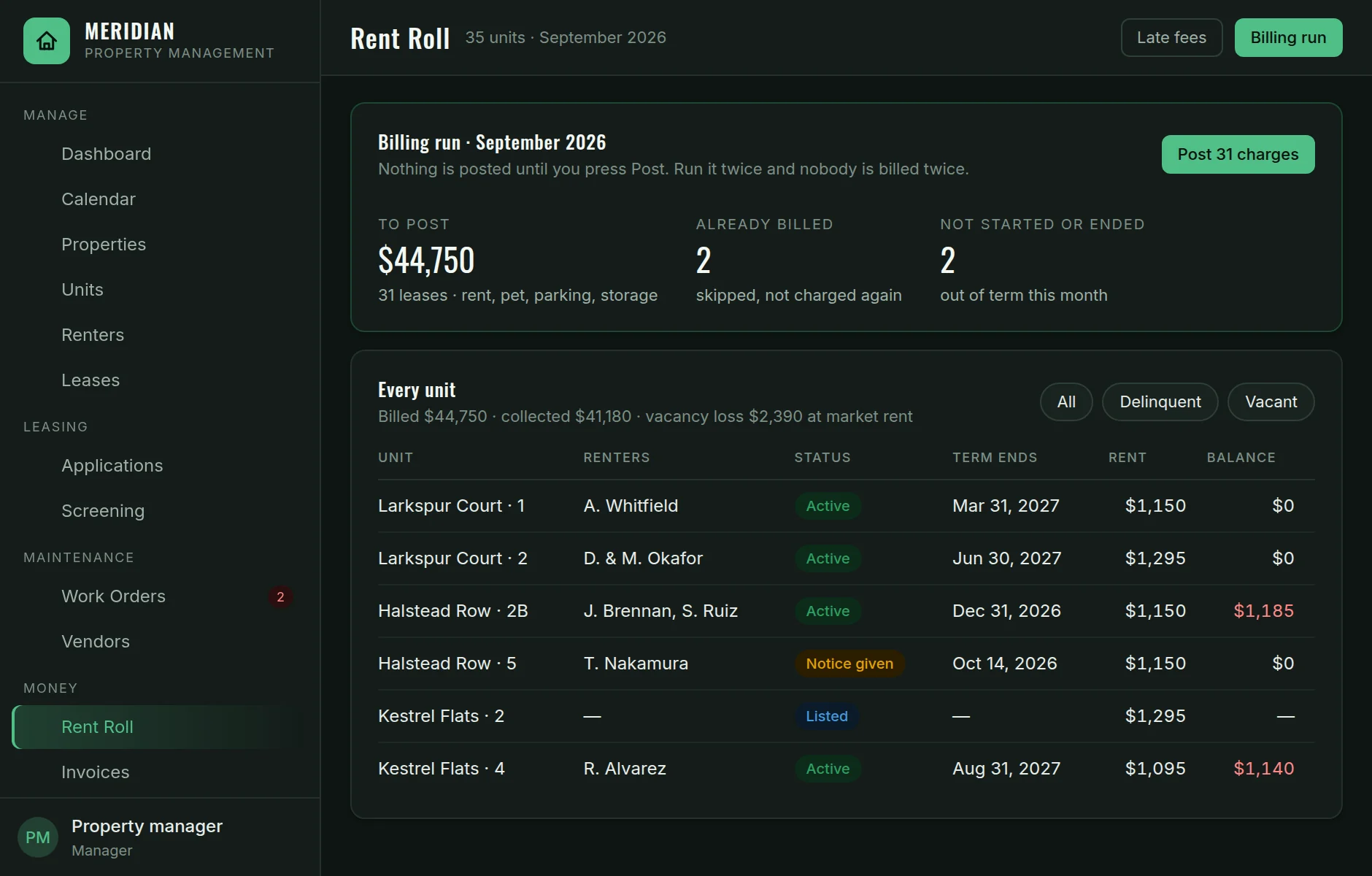
Rent does not post itself. A billing run is the least reversible thing in the product, so it happens when a person decides it does — after reading exactly what it is about to do.

  • Preview first: every lease, what would post, the total, and which are already billed
  • Safe to press twice — a lease already billed for the month is skipped, not charged again
  • Late fees the same way, only where the balance was still unpaid at the end of grace
  • Vacancy loss in the totals, priced at market rent, so an empty unit feels like the expense it is
The Haven rent roll: a billing run preview showing the amount to post, how many leases are already billed and how many are out of term, above a table of every unit with its renters, status, term end, rent and balance.
Also in the box

The parts nobody demos, and everybody uses

A dashboard that tells you what will cost youFailed and returned payments, urgent repairs, leases ending with no renewal offer out, screened applications with no decision, and insurance about to lapse — ordered by how much it matters.
A calendar nothing is typed intoScheduled repairs, lease starts and ends, notice deadlines and the days rent is due — every entry derived from a record that already exists, filterable to one property.
Invoices that describe charges rather than create themBuild one for a lease and period, or batch a whole month. Voiding an invoice releases its charges to be invoiced again and never touches the money owed.
Area figures from the Census Bureau and HUDMedian home value and median rent by bedroom count for the ZIP code, beside HUD's Fair Market Rents. Free federal data, shown for information — nothing in Haven is priced from it.
Roles that actually restrictOwner, admin, manager, staff and maintenance. The financial reports do not appear at all for the roles that should not see them.
Your company's colors, onceAccent, shades, typeface, corner radius and density are set for the whole office — and each person still chooses dark or light for themselves.
Straight answers

Common questions about Haven

Can renters pay their rent inside Haven?

Not yet. Renters pay you the way they pay you today — your bank, your card terminal, a check in the office — and your office records the payment against the lease. Card and bank processing inside Haven is being built; when it lands, money will move through your own account, not ours.

Is there a renter portal?

Not yet. Haven today is the office application. A renter portal carrying your own branding is planned, and it will share the same records rather than being a second copy of them.

What does the property valuation cost?

Nothing. It indexes what you paid forward using the house price index the Federal Housing Finance Agency publishes for your ZIP code. There is no data service to sign up for and nothing to switch on. Where the index does not reach a ZIP code, Haven falls back to the state figure and says so on the page.

Does Haven decide who to approve?

No, and it will not pretend to. It checks a screening report against the policy you set and shows each test passing or failing as advice. The decision is the landlord's — and when a decline, or an approval with a condition, is based on that report, Haven writes the adverse-action notice the applicant is owed.

Does it email my renters?

Not today. Marking an invoice sent is your record that it went out, not an instruction to Haven to send it, and printing is your browser's. We would rather say that plainly than have you find out on a rent day.

Can I try it now?

Haven is in development and trials open at launch. Tell us how your portfolio is set up — how many properties, how many units, how rent comes in — and we will show you what Haven does with it and tell you the moment it opens.

Managing rental property?

Tell us how your portfolio is set up and we will show you what Haven does with it. The guide walks through the whole product, screen by screen, in the meantime.

Get notified at launch Read the guide Contact Us